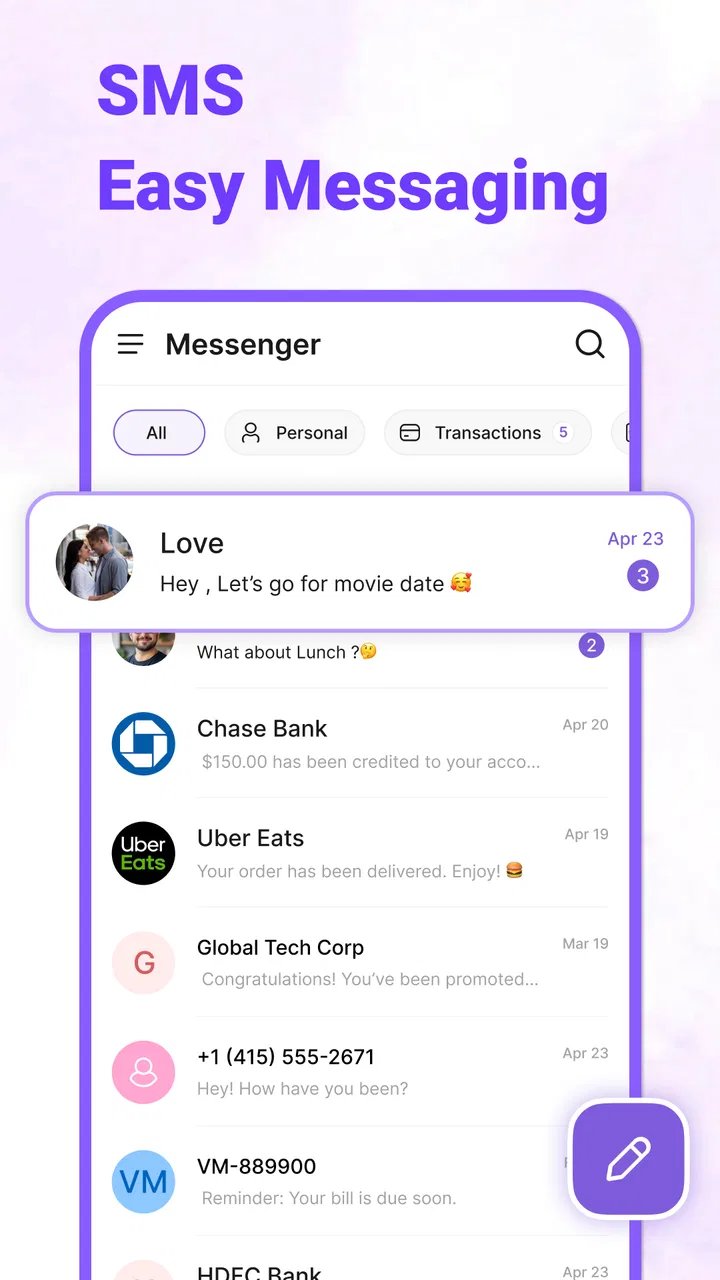
Messages: Text SMS Home
- 3.8
- Rating
- 100.00K
- Installs
- Free
- Price

 Analysis by App-foxy
I approached Messages: Text SMS Home as a small communication utility rather than a full replacement for every messaging tool on a phone. Its purpose is straightforward: it puts access to text messages and SMS on a simple home screen. That sounds modest, but it can be useful if your main frustration is having to search through menus before reaching ordinary conversations.
The app is free to download, carries an Everyone age rating, and comes from the developer Photo - Picture keyboard. It has attracted over ten thousand installs and holds a 4.3 average from 74 ratings, which suggests a generally positive first impression while also reminding me that this is a relatively small app community. The current release is version 1.0.3, and it requires Android 10 or newer.
My overall experience is that the value here depends less on advanced messaging tools and more on whether a direct home-screen route fits the way you use SMS. If you mostly send standard texts and want a simpler starting point, it may feel convenient. If you expect a feature-rich messaging suite, a highly customizable launcher, or a complete replacement for the messaging app already built into your phone, you should set your expectations carefully.
You May Also Like

 Blood Strike: 2.5 Anniversary
Blood Strike’s Loadouts Turn Every Drop Into a Tactical Gamble
A close look at Blood Strike’s custom loadouts: how fast access to signature weapons reshapes its battle royale rhythm, rewards preparation, and narrows the gap between fights.

 Pandora - Music & Podcasts
Pandora’s Music Is Easy to Start, but Harder to Recover
Pandora’s strength is its low-effort path from a seed to a station. Its weak spot is how much confidence it asks you to place in connection, setup, and quiet recovery.

 8 Ball Pool
 Is Built on Rivalries, Rematches, and Routine
A close look at the rivalries, rematches, shared routines, and unanswered safety questions that turn a quick pool match into a persistent mobile community.

 Samsung Music
’s Quiet Strength Is Playing What You Already Own
Its reach comes less from spectacle than from dependable access to a personal library. That simplicity is both the app’s strongest retention engine and its ceiling.

 AccuWeather: Weather Radar
AccuWeather Review: A Quick, Clear Forecast for Everyday Decisions
For everyday plans, the best forecast is the one you can understand quickly. AccuWeather makes rain timing, radar, and local conditions easy to act on, with a few trade-offs.

 Hill Climb Racing
Why Hill Climb Racing Still Turns Crashes Into One More Run
A tiny car, a bumpy hill and one more upgrade: Hill Climb Racing keeps resurfacing because its simple chaos makes every near-miss feel personal.
More From Our News Desk
View All News


Getting past the points where setup can feel unclear
The first place I would expect users to hesitate is the difference between opening messages quickly and replacing the phone’s underlying SMS system. A home-screen shortcut can make conversations easier to reach, but that does not automatically mean every messaging function has moved into this app. Before judging it, I would first open an existing conversation, check whether the expected messages appear, and try the normal reply action.
That simple test matters because SMS handling can involve more than one application on Android. The app may be acting as a convenient access point while the phone continues to rely on its established messaging behavior. If you see a familiar messaging screen after selecting a conversation, that is not necessarily a failure. It may simply be the way the shortcut connects you with the phone’s existing text workflow.
I would also avoid changing several phone settings at once. Install the app, place or open its home-screen entry, and test one known conversation before experimenting with defaults. This makes it much easier to identify whether the problem is the app, the launcher, or the phone’s current messaging configuration. The best setup habit is to change one thing, test it, and only then change the next.
What I would check before blaming the app
Start with the basics: confirm that the device runs Android 10 or later, make sure the app is the current version shown in the store, and restart the phone if the home-screen entry does not appear correctly. A restart is especially sensible after installing a utility whose main purpose is to provide a quicker route from the home screen.
Next, open the app directly instead of tapping a shortcut. If it works from the app list but not from the home screen, the issue is probably related to the launcher or the shortcut rather than the message access itself. Removing and recreating the shortcut is a reasonable general fix. I would not immediately uninstall the app or erase messaging data, because that can create a larger problem than the original inconvenience.
If conversations appear but a particular thread does not, compare it with another known thread. One missing contact does not prove that the whole application is broken. The contact may be stored differently, the conversation may be archived elsewhere, or the phone’s own messaging organization may be affecting what is shown. Testing with more than one conversation gives you a much clearer picture.
There is also a practical distinction between SMS and internet-based chat. A simple text utility is not automatically the same as a service built around online accounts, media-heavy conversations, or encrypted messaging. If you are trying to reach a chat that normally lives in another service, Messages: Text SMS Home may not be the right doorway. I would use it for ordinary text-message access, not assume that every conversation on the phone belongs there.
A realistic morning workflow
Imagine that I am leaving home and need to answer a short text from a family member. With the app’s home-screen focus, I can begin from the phone’s main screen instead of searching through a crowded app drawer. I would tap the entry, select the conversation, read the latest message, and reply using the messaging flow that appears.
The advantage is not dramatic automation; it is reduced friction during a small, repeated task. That makes the app more appealing to someone who checks SMS several times a day than to someone who sends only an occasional text. It could also suit a phone with a deliberately simple home screen, where one obvious message entry is easier to recognize than a collection of unrelated icons.
There is a trade-off, though. A shortcut-based workflow can be less useful if your home screen is already organized around a different messaging app. In that case, adding another entry may create uncertainty rather than remove it. I would keep only the route that feels most obvious and remove duplicate shortcuts if I found myself pausing to decide which messaging icon to use.
Recovering when the workflow does not behave as expected
When a message route seems stuck, I would troubleshoot in layers. First, return to the home screen and open the app again. Then try a different conversation. If only one thread causes trouble, the issue is probably narrower than a complete app failure. If no conversations open, close the app, reopen it, and restart the phone before making more invasive changes.
Another useful recovery step is to check whether the phone has recently changed its default messaging arrangement. Android devices can present similar options in different places, so I would look through the phone’s application settings for messaging defaults and confirm that the choice still matches my intended workflow. I would be cautious about selecting a new default simply to make a test work, because changing defaults can affect how other message links and notifications behave.
If the home-screen entry disappears, recreate it rather than assuming the messages themselves are gone. A shortcut is only an access point; removing it should not be treated as deleting conversations. I would also check whether the launcher has a separate area for widgets or shortcuts, since home-screen tools are not always placed in exactly the same way across Android phones.
For a message that appears delayed, I would first consider the phone’s connection and the normal behavior of SMS delivery. The app can provide a route to messages, but it cannot make a mobile network deliver a text instantly. Waiting briefly, checking another conversation, and confirming whether the phone can send or receive ordinary texts are more useful first steps than repeatedly tapping the same screen.
Small habits that make the app easier to live with
I found three habits especially practical. First, keep the app’s entry in a predictable location instead of moving it between home-screen pages. The whole point is immediate access, and a shortcut that keeps moving defeats that purpose. Second, test both opening and replying during setup; reading a conversation alone does not tell you whether the complete everyday workflow feels comfortable.
Third, use a known recent conversation as a test thread rather than an old or unusual message. A recent thread gives you a clear reference for what should appear and makes it easier to notice whether the app is showing the expected content. This is a simple diagnostic trick, but it prevents users from mistaking an unusual conversation for a general problem.
I would also decide early whether this app is meant to be the main route to SMS or merely a convenient backup entry. Using it as a backup can be sensible if you like its home-screen access but prefer another app for composing, organizing, or managing conversations. Treating it as a total replacement without testing those broader tasks may lead to disappointment.
When the phone, network, or another app is responsible
It is easy to blame the newest installed application when a text does not arrive, but SMS depends on the phone, the mobile connection, and the messaging system already in use. If messages fail everywhere on the device, Messages: Text SMS Home is unlikely to be the main cause. I would test the phone’s ordinary messaging route, check whether other texts work, and consider whether the issue affects sending, receiving, or only displaying a conversation.
Notifications are another area where the app may not be responsible. Notification behavior can be controlled by the phone’s system settings or by another messaging application. If a message opens correctly but no alert appears, I would inspect the phone’s notification settings and the settings of the app that normally handles incoming texts. I would not assume that a home-screen access tool controls every alert generated by the device.
Storage and system maintenance can matter as well. If the phone is nearly full or behaving unusually across several apps, clearing space and restarting it may help more than reinstalling this one. Reinstallation should be a later step, especially when messages are important. Before removing any communication app, I would make sure I understand where conversations are stored and how the phone handles them.
There is also a privacy and convenience decision in choosing any SMS access tool. I would use the app only if its behavior makes sense to me and if I am comfortable with the way it fits into the phone’s messaging setup. The store places it in the communication category, but that label alone does not tell me whether it offers the organizational depth of a mature messaging client. For sensitive conversations, I would favor a workflow I can clearly understand and control rather than choosing an app solely because its icon is easier to reach.
How it compares with the usual alternatives
The built-in messaging app remains the most natural alternative. It is usually already connected to the phone’s SMS behavior and may offer more familiar controls for contacts, threads, notifications, and message composition. If your current app is working well, the main reason to try Messages: Text SMS Home is convenience at the home-screen level, not a promise of a completely different messaging system.
A full third-party messaging client may be a better choice for someone who wants richer organization, broader customization, or a more established set of communication tools. Those apps can make more sense for users who manage many conversations and need detailed controls. The trade-off is that they may feel heavier than a simple entry point, while this app’s appeal comes from keeping the path to SMS uncomplicated.
Internet messaging services are a different comparison altogether. They can be preferable for group chats, media sharing, or conversations that do not rely on standard SMS. Messages: Text SMS Home is better judged as a focused way to reach text messages, not as a competitor to every online chat platform. Choosing between them depends on where your contacts actually communicate.
Who should install it and who should skip it
I can recommend trying it to someone who wants a direct, uncomplicated route to SMS from the home screen, especially if the phone feels cluttered or the existing messaging entry is hard to find. It may also suit a person who values a minimal starting point and does not need a large collection of communication features.
I would hesitate to recommend it to a user who expects advanced message management, a complete replacement for a preferred messaging client, or access to conversations from unrelated online services. It is also not the first thing I would investigate when texts fail across the entire phone. In that situation, the network, device settings, or underlying messaging app deserve attention first.
The free price makes testing relatively easy, although in-app purchases range from $5.49 to $24.99 per item. I would look at those options carefully before paying, and I would first decide whether the basic home-screen access solves a real daily problem. A purchase is difficult to justify if the app merely duplicates an icon that is already easy to reach.
My practical verdict after using it
Messages: Text SMS Home is a focused communication app with a clear everyday purpose: make SMS reachable from a simple home-screen starting point. I like that its usefulness can be understood quickly, and the 4.3 average indicates that many early users have found the basic idea worthwhile. Its current version, 1.0.3, also gives users a concrete release to check when troubleshooting installation or behavior.
My recommendation is conditional but positive. Try it if your problem is access and simplicity, then test opening and replying to a real conversation before reorganizing the rest of your phone. If it makes SMS feel more immediate without creating duplicate routes, it earns its place. If you need deeper controls or your messages are failing everywhere, choose the built-in or more established messaging option instead.
In short, I see this as a useful front door to text messages rather than a universal communications platform. Its strongest feature is the reduction of small daily friction, while its main limitation is that simplicity may not satisfy users looking for a complete messaging toolkit. That balance makes it worth a careful trial, but not something I would install without first identifying whether home-screen access is genuinely the part of SMS that slows me down.
FAQs for Messages: Text SMS Home
01What is Messages: Text SMS Home and how does it work?
Messages: Text SMS Home is an app designed to enhance your texting experience by providing a centralized hub for all your SMS and MMS messages. It includes customizable themes, notification sounds, and quick reply options. The app integrates smoothly with your contacts, making communication easy and efficient.
02Is Messages: Text SMS Home free to use, and does it include any in-app purchases?
Yes, Messages: Text SMS Home is free to download and use. However, it may offer in-app purchases for premium features such as advanced customization options or ad-free experiences. Prices for these features can vary, so it's worth checking the app store for specific details.
03Can Messages: Text SMS Home replace my default messaging app?
Yes, Messages: Text SMS Home can replace your default messaging app. Upon installation, it will prompt you to set it as your default SMS and MMS app, allowing it to handle all your messaging needs. You can switch back to your original app at any time if desired.
04What are the main features that set Messages: Text SMS Home apart from other messaging apps?
Messages: Text SMS Home offers a range of features that distinguish it from other apps, including customizable themes, unique notification settings, quick reply options, and an easy-to-navigate interface. These features enhance user experience and provide a personalized touch to your messaging.
05Is Messages: Text SMS Home secure, and how does it handle user data?
Messages: Text SMS Home prioritizes user privacy and security by encrypting messages and protecting personal information. It complies with data protection regulations and does not share user data with third parties without consent. Users should review the privacy policy for comprehensive details.
Pros
- Simple and intuitive user interface.
- Supports multimedia messaging.
- Reliable message delivery.
- Customizable notification settings.
- Secure with end-to-end encryption.
Cons
- Lacks integration with third-party apps.
- No advanced search features.
- Limited customization options.
- Ads can be intrusive at times.
- Requires frequent updates for stability.

Messages: Text SMS Home
Gallery